SEO for Senior Living and Assisted Living: A Complete Guide
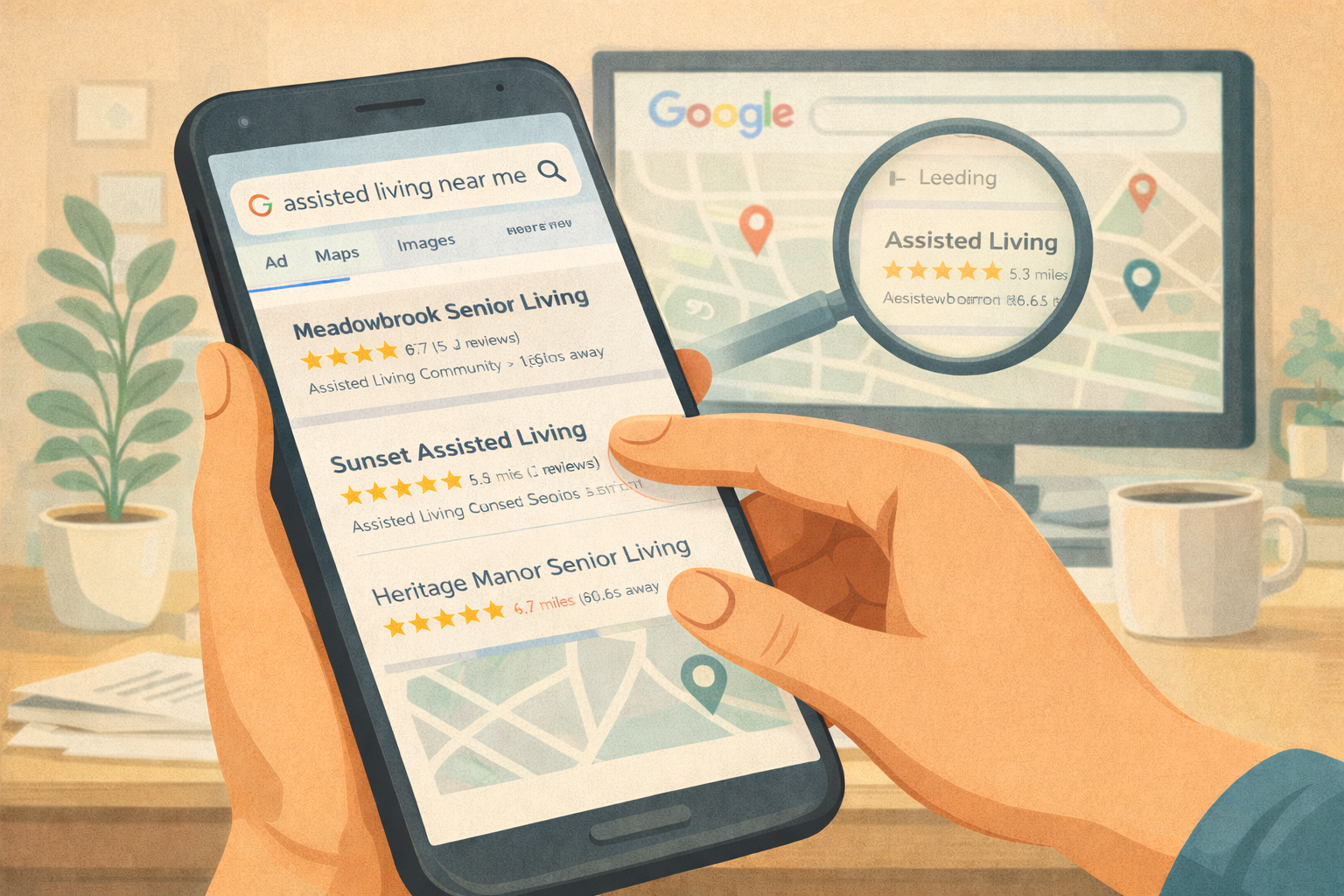
Search Engine Optimization, or SEO, is the process of making your website show up high in Google and Bing search results without paying for each click. Strong senior living SEO and assisted living SEO build long-term visibility and trust for your community, while paid ads bring fast results. When you rank well in both paid search and organic results, you can appear up to four times at the top of a Google results page, dominating visibility for families searching in your area.
Why SEO Matters for Senior Living and Assisted Living
When families search for senior living, assisted living, independent living, or memory care, they often research extensively before reaching out. In fact, it's now normal that the bulk of the buying process happens before anyone talks to a salesperson. Being present in organic search results signals credibility and helps you become the obvious choice.
Most people only ever click the very top 3 results on a search results page. If you're not there, you're invisible to most potential residents and their families.
SEO for Every Care Type: Assisted Living, Memory Care, Nursing Homes, and Care Homes
Search behavior differs by care type, so your strategy should too. The fundamentals below apply across the board, but the exact-match phrases families type will vary. Build pages and content around the terms that match what you offer:
Assisted living SEO — target phrases like "assisted living in [city]" and "assisted living cost in [city]."
Memory care SEO — families search "memory care near me" and "dementia care facility in [city]."
Nursing home SEO and care home SEO — cover "nursing homes in [city]" and, in some markets, "aged care" and "care home" phrasing.
Senior care SEO and senior living SEO — the umbrella terms that tie your location and service pages together.
Whether your focus is nursing home SEO, care home SEO, or senior care SEO, the principle is the same: give Google (and families) a dedicated page that directly answers each specific search.
SEO for Nursing Homes: A Different Search Landscape
SEO for nursing homes is distinct from assisted living or memory care SEO because the search intent is different. Families searching for a nursing home are often dealing with a more acute medical situation: a hospital discharge, a sudden decline, a need for skilled nursing care. That urgency changes what they type and how quickly they decide.
Key differences for nursing home SEO:
- Terminology matters: Many people search "nursing home near me" while others use "skilled nursing facility" or "SNF." Your content should use both terms naturally so you capture the full range of searches. "Nursing home" is the consumer-friendly term; "skilled nursing facility" or "SNF" is what healthcare professionals and Medicare resources use.
- Medicare and insurance intent: Nursing home searchers often include filters like "Medicare-certified nursing home" or "nursing home that takes Medicaid." If you accept these, say so clearly on your nursing home pages.
- Google Business Profile categories: Make sure your GBP listing uses "Nursing home" or "Skilled nursing facility" as a category if that is the service you offer. Wrong categories hurt local pack visibility for nursing home searches.
- Star ratings and reviews: The Medicare Compare nursing home star rating shows up in search results and affects click-through rate. Families searching for nursing homes will see it, so it is worth understanding how it factors into their perception of your listing.
For SEO for memory care facilities, the approach is similar: use both "memory care" and "dementia care" in your content, since families use both terms, and build location-specific pages that target "memory care in [city]" directly.
Create a Page for Each Location and Service Type
One of the most important SEO fundamentals for senior living is having a separate page for each location and each type of service you offer, such as assisted living, memory care, or independent living. Most senior living companies have multiple locations, so creating unique pages for each one helps you rank for searches in each specific area.
If you have 10 locations, each deserves its own page. And if you have a separate memory care facility or senior apartments at some of those locations, consider giving each of those their own pages, too. When someone searches for "dementia care facility in [your city]," both you and Google want to show them a page that directly answers that search.
Optimize Your Google Business Profiles
When you search for a local business like assisted living, you'll see a "maps pack" of usually 3 results with Google reviews. As a business owner, this is your Google Business Profile (GBP). Claim and fully optimize a separate profile for each location:
Add accurate contact information and your exact address
Select the right service categories
Add photos of your facility, staff, and residents
Regularly update with images, videos, and posts to keep profiles fresh
Earn and Respond to Google Reviews
Families rely heavily on reviews when choosing senior living options. Encourage happy residents and family members to leave detailed reviews on your Google Business Profiles. Just as importantly, respond to every review, whether positive or negative. This shows you care and helps improve your rankings.
Imagine you've never heard of your community. If competitors have more reviews and better ratings, who will families trust more? Responding professionally to negative reviews is also important, because other people will see your response and it shows character.
Directory Listings and Citations for Local SEO
Make sure your business is listed consistently on key online directories. Examples include Yelp, SeniorAdvisor, Caring.com, and local business directories. Your Name, Address, and Phone Number (NAP) must be identical across all listings.
Choose a standard format for your NAP and keep it perfectly consistent across your website location pages, Google Business Profile, Facebook page, and everywhere else. This consistency shows search engines that you're a legitimate business with trustworthy information.
Senior Living Keywords and Content Strategy
Target search keywords with strong intent when planning your SEO content strategy. Building your senior living keywords list starts with the phrases families actually type. For senior living SEO and assisted living SEO, focus on terms like:
Assisted living in [city or metro area]
Memory care near me
Senior living community [location]
Assisted living cost in [city]
Create pages and content around these phrases. You don't need to say "near me" on your pages, but you should include your city, county, and/or metro area naturally throughout the content.
SEO Blogging for Senior Living
A blog helps you answer common questions families have, like "When is the right time for memory care?" or "How much does assisted living cost in [city]?" Regular blog posts bring in new visitors from organic search and demonstrate your expertise and authority.
Really good blog articles can also give other websites a reason to link to yours, which is one of the most powerful ranking factors for SEO. You can use AI to help draft blog posts, but we recommend adding your own real-world experience and expertise to any post you publish to make it stand out.
Link Building and Domain Authority
Search engines look at how many reputable websites link to your website as a sign of authority. You can earn links through local sponsorships, partnerships, guest blog posts, going on podcasts, or being mentioned in news stories. Building authority over time is a key part of SEO success.
If you're wondering why competitors show up above you, it's often because they either have more optimized pages for target keywords or because they have more high-quality backlinks from other websites. SEO tools like Ahrefs and SEMrush can help you understand how your site compares to the competition.
Foundational SEO vs. Ongoing SEO
Think of senior living SEO in two phases:
Foundational SEO:
Researching keywords
Creating the right pages for your locations and services
Optimizing those pages with target keywords, titles, and meta descriptions
Making sure everything works well technically (fast load times, mobile-friendly, no broken links)
Claiming and building out your Google Business Profiles
Adding your information to important online directories
Ongoing SEO:
Earning and responding to Google reviews
Publishing informational blog content and linking back to your location pages
Building backlinks from other websites
Monitoring and further optimizing your existing pages
Measuring results with Google Search Console and Google Analytics
While it takes time to see SEO results in terms of leads and sales, the long-term payoff is consistent inquiries without paying for every click. Any one of those organic website visitors could lead to a resident move-in.
Working With a Senior Living SEO Company
Some communities handle SEO in-house; others partner with a senior living SEO company or agency that specializes in the space. A good senior living SEO service will build out your location and service pages, optimize your Google Business Profiles, earn reviews and backlinks, and measure everything so you know what's driving move-ins.
What separates a strong assisted living search engine optimization program from a generalist approach? Care-type specificity, GBP expertise, and conversion focus. A dedicated assisted living SEO company optimizes separately for assisted living, memory care, independent living, and skilled nursing, each with its own keyword cluster and user intent. The best assisted living SEO services treat Google Business Profiles as equal in priority to your website, because local pack rankings often drive more inquiries than organic listings. Every metric should tie back to tours booked and move-ins, not just sessions.
At Silver Path Marketing, we provide SEO for senior living and assisted living communities, from foundational setup through ongoing content and link building. If your community also needs to organize and follow up on the leads SEO generates, see our guide to choosing a senior living CRM.